13 Minuten
How The ‘Sound of Space’ Evolved from a project to a book
Appropriately, the Companion did not begin as a book at all, but as a project for a spatialised musical performance: a duet for violin and cello that asked the simple question of ‘what happens when architecture is treated not merely as a host for music, but as a collaborator in its composition and performance?’ The work was performed in two radically different architectural and acoustic environments. Firstly, the acoustically dry anechoic chamber in the basement of a University College London building, and secondly, the highly reverberant interior of Antoni Gaudí’s Basílica de la Sagrada Família in Barcelona. Observing these performances across two highly contrasting environments made clear that architecture does far more than just contain sonic material – it actively collaborates in how sound and music is performed, heard, and understood. This discovery forms the subject of my own chapter in the Companion.1
Recording of opening few bars of C002, in the anechoic chamber
Anechoic recording of opening few bars of C002 processed with a 'generic large cathederal' effect in ableton Live
Anechoic recording of opening few bars of C002 convolved with an IR simulated by CATT Acoustic, with musicians in position 1.
Anechoic recording of opening few bars of C002 convolved with an IR simulated by EAR for Blender, with musicians in position 1
Recording of opening few bars of C002 as physically captured in the Sagrada Familia, with musicians in position 1
Following these performances, and the many discussions and encounters that unfolded around them, I met many other practitioners working across related fields, and it soon became clear that there was a strong appetite for sustained dialogue between spatial and sonic practitioners across architecture, acoustics, music, and sound art. In response, Jane, Mark and I organised a two-day international symposium that invited presentations, performances, and seminars from acousticians, sound artists, musicians, architects, and spatial designers. Through this event, we aimed to survey the current state of the art, to better understand the key questions emerging between these fields, and to identify points of resonance, friction, and productive tension within this shared territory.
The symposium quickly revealed the need for a longer-form platform, both as a record of these conversations, and as a comprehensive resource for practitioners, scholars, and researchers working in, and in-between spatial and sonic practices. The Companion therefore became both documentation and invitation, disseminating new knowledge whilst also encouraging the continuation and expansion of a rich interdisciplinary and international conversation that was already well underway.
Space and sound as collaborators
Using the themes that emerged from the symposium as an initial framework, the book is organised as a matrix in which spatial typologies, ranging from Extreme, Exterior, and Domestic or Interior spaces to Performative and Public, Socio-political, and Virtual or Technological environments, are mapped against the four thematic strands of Architectural Acoustics; Psychology and Physiology; Philosophy and Politics; and Music and Sound Art. This structure reflects the inherently transdisciplinary nature of the field, and enables readers to move between technical, artistic, and theoretical perspectives.
Importantly, no fixed writing style or format was imposed on contributors. Given the breadth of disciplinary backgrounds represented, it felt essential that each author could write in a way that made sense within their own methodological and epistemological frameworks. As a result, the volume includes content in the form of embodied project reflections, technical engineering analyses, artistic manifestos, and philosophical essays, sitting alongside one another in a deliberately heterogeneous format.
Across these contributions, ‘space’ is positioned not merely as a container of sound but as a conceptual and material agent in sound-making, and ‘sound’ is likewise understood as an active agent in space-making. This reframing invites new modes of practice, pedagogy and research, particularly within architecture and music, where space is too often treated as a neutral host rather than as something with its own intellectual and practical capacity to collaborate. For practitioners, researchers and educators working across creative and technical disciplines, the Companion’s implications are distinctly practical: sound-led methodologies, including impulse response recording, acoustic-responsive composition and performance, sound spatialisation and critical listening practices, are articulated here as forms of embodied enquiry. Equally, architectural design, encompassing materiality, tectonics, geometry and broader socio-political and philosophical questions of space, is brought into direct and reciprocal relation with sound and music.
Resonance, bodies, access
Although the authors were not given prompts or guiding themes at the outset, as we wanted genuinely unmediated accounts of how people are thinking and working across sonic and spatial realms, a number of key themes recur across the chapters, refracted through very different disciplinary lenses. Resonance is perhaps the most pervasive of these, appearing not only in acoustical analyses of reflected sound,2 but also in philosophical discussions of affect, memory and cultural space.3
Acoustic shadows in plan and section
Simulation stills of sound in a 2D corridor made of rigid boundaries that progressively increase in curvature and perforated openings. The top still references an earlier time step. From left to right the energy is coherent, then dispersed, then reduced, indicating continuity between acoustic reflection, diffusion, and absorption.
The two-layered wall system of Long Range with shifting variations in curvature, openings, and direction of curvature.
Similarly, embodiment emerges through accounts of performance as research, where bodily presence within a space becomes a method for understanding acoustic and spatial behaviour, alongside socio-cultural structures.4 Listening is also repeatedly framed as a spatial practice. Rather than a passive sensory act, it is treated as an active mode of engagement with architecture, environment, and social context.5
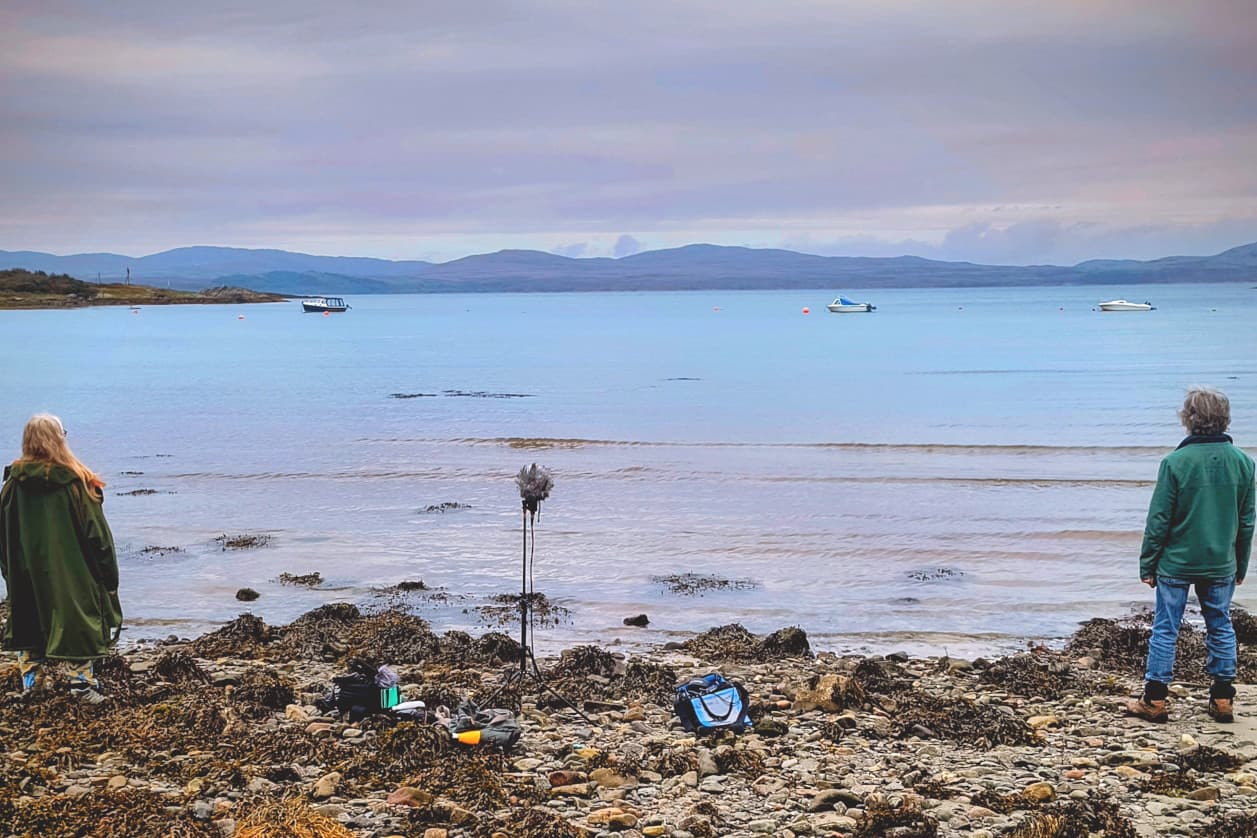
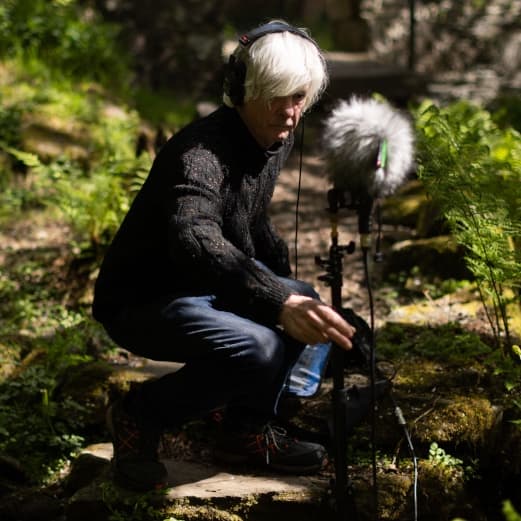
This also extends into practice-based and field-based methods. Philip Samartzis’s contribution, for instance, traces how fieldwork and site-specific recording constitute their own forms of spatial listening, grounding the act of hearing within particular environments, ecologies, and histories.6
Casey Research Station was recorded during the most intense blizzard ever registered during the austral summer at the station to that time (2016) with winds gusting around 100 knots.
Jimblebar Iron Ore Mine was recorded around 4am directly outside the gatehouse used for traffic control. The train featured in the recording is around 3 kilometres long and comprises 230 cars each containing 100 tonnes of iron ore. The train is bordered by bat and frog call which progressively gets louder in an attempt to communicate above the sound of the passing train.
Bogong Powerstation Turbine Hall comprises a series of recordings made inside the power station while it was generating hydroelectricity. I managed to locate a microphone adjacent to the penstock used to spin the blades in a turbine, which, in turn, spins a generator that produces electricity.
Several chapters engage directly with the spatialisation of sound as both a technical and compositional practice, encompassing binaural and Ambisonic approaches, loudspeaker arrays, and the simulation and construction of immersive (and personal) listening environments.7
Variable reflectors (left) are independently addressable to enable a modulated envelope (right) to be evolved from biometric responses to input stimuli.
Deconvolved Electrodermal Activity shown below analysis of the source stimuli, in this case a section of Beethoven’s 7th Symphony. The red lines on the EDA graph represent recorded emotional change. This represents a positive valence, which was triangulated with the post-test questionnaire.
The audio file ‘Coldstores Mix’, included here, is an anonymous compilation of 3 evolved soundscapes undertaken during the experiments. The concept of ‘music’ is deconstructed into a series of acoustic / compositional actions that match existent modes of acoustic understanding. To quote Edgard Varèse, ‘Music is organized sound’ (Varèse & Wen-Chung1966). Thus ‘sounds’ were to be generatively optimized in such a way that may reflect a language of musical acoustics, and can be described in qualitative and quantitative terms, just as space is to be generatively optimized to suit the understanding of music in the sister experiment. The outputs presented here come from not a piece of music or composition, but an ‘aesthetically potent environment’ (Pask 1971) that has agency over its occupation.
These include discussions of tools that simulate acoustic conditions through ray tracing and digital modelling, and the use of three-dimensional impulse responses in the design of spaces for music and sound art. Crucially, such technologies are treated not only as instruments of prediction and optimisation, but as compositional tools in their own right, enabling artists to make music with and for specific architectural conditions, and to design bespoke acoustic environments in response to emotional and perceptual criteria.8 These themes speak directly to the spatial audio technologies that lie at the heart of the work made and encountered by the Sounding Future community.
Throughout the Companion, spatial sound is then framed not only as an aesthetic tool but as a social and cultural enabler, one that can support community engagement, education and collective experience. The book’s concerns also extend beyond the experience of sound in space, as several chapters address vibrational and material transmission, exploring how sound travels through the bodies and materials of space itself, rather than simply through the air it contains.9 This shifts attention away from reverberation and reflection towards the ways in which physical structure and material composition are themselves productive of sonic experience. Related to this, the book also engages with questions of aural diversity, considering how those with different sensory relationships to sound, including people with hearing impairments, perceive and navigate architectural and urban space.10 These discussions all carry practical implications for urban and architectural designers, and reflect the book’s broader ambition to move beyond acoustics as the default lens through which sound and architecture are understood, opening onto questions of politics, ethics and sonic access.
From pages to practice
Since its publication, the Companion has already catalysed a range of activities extending well beyond the printed (and E-Book) volume. These include workshops on Vibrational Architectures led by contributors Gascia Ouzounian and Jonathan Tyrrell, alongside seminars and study groups addressing pressing practical questions around commissioning, archiving, and policy frameworks surrounding sound art and spatial performance. Questions of how to archive the intangible, particularly spatial and ephemeral sonic works, have also emerged as a recurring thread linked directly to the book’s themes, and one that has drawn in artists and thinkers beyond the original circle of contributors.
Within UCL, the book has prompted new conversations between researchers working on sound and music across departments, culminating in the book launch, concert, and exhibition at The Bartlett School of Architecture in January 2025. This in turn contributed to my role as co-organiser of the Computer Music Multidisciplinary Research (CMMR) conference in 2025, themed around sound, music, space and place.11 This conference was hosted between UCL East and the V&A East Storehouse, and evolved into a three-day exploration of what we termed a ‘sonic museum’, or the idea that a conference about sound, music, space and place should not be confined to talks alone, but should encompass performances, installations and public engagement. It brought together academics, practitioners, students and members of the public, creating what felt like a more holistic ecosystem of sonic and spatial exchange.
Video: Spatialised playback of Emma-Kate Matthews' performance "Perfect Cyan Bright Square" in the gallery space at V&A East Storehouse
It was through this conference that I first encountered the Sounding Future platform, and whilst the platform itself long predates the book, this encounter is perhaps emblematic of how the book and its associated events have expanded my own networks and opened up new conversations and collaborations.
What comes next?
Editing the Companion was, in many ways, an exercise in listening to sound, but also to many disciplinary languages, methods, priorities and questions. I was already aware that architectural and musical practices are inherently collaborative and expansive. However, the editorial process revealed the true breadth of these fields and the remarkable diversity of approaches operating within it, at this point in time.
One of the most revealing insights was how many practitioners were independently grappling with similar questions around space, sound, embodiment and technology, yet often without a shared platform for dialogue. Bringing these voices together made visible an emerging field, one still in the process of defining its own methods and terminology, and committed to continuing to do so.
At the same time, the process highlighted many areas that remain underexplored. These include the long-term archiving of spatial sound works, the integration of spatial audio into mainstream design education, and the role of fabrication and material experimentation in sonic practice. These are all areas that are increasingly central to my own work as a spatiosonic practitioner.12
I always hoped that the book would live a life beyond its pages, prompting conversations, collaborations, and new forms of practice. Encouragingly, this is already happening. Rather than acting as a conclusion, the Companion now feels more like a snapshot of a rapidly evolving field, one that will continue to expand as spatial audio technologies, architectural design tools, and artistic methodologies become ever more intertwined and entangled.13
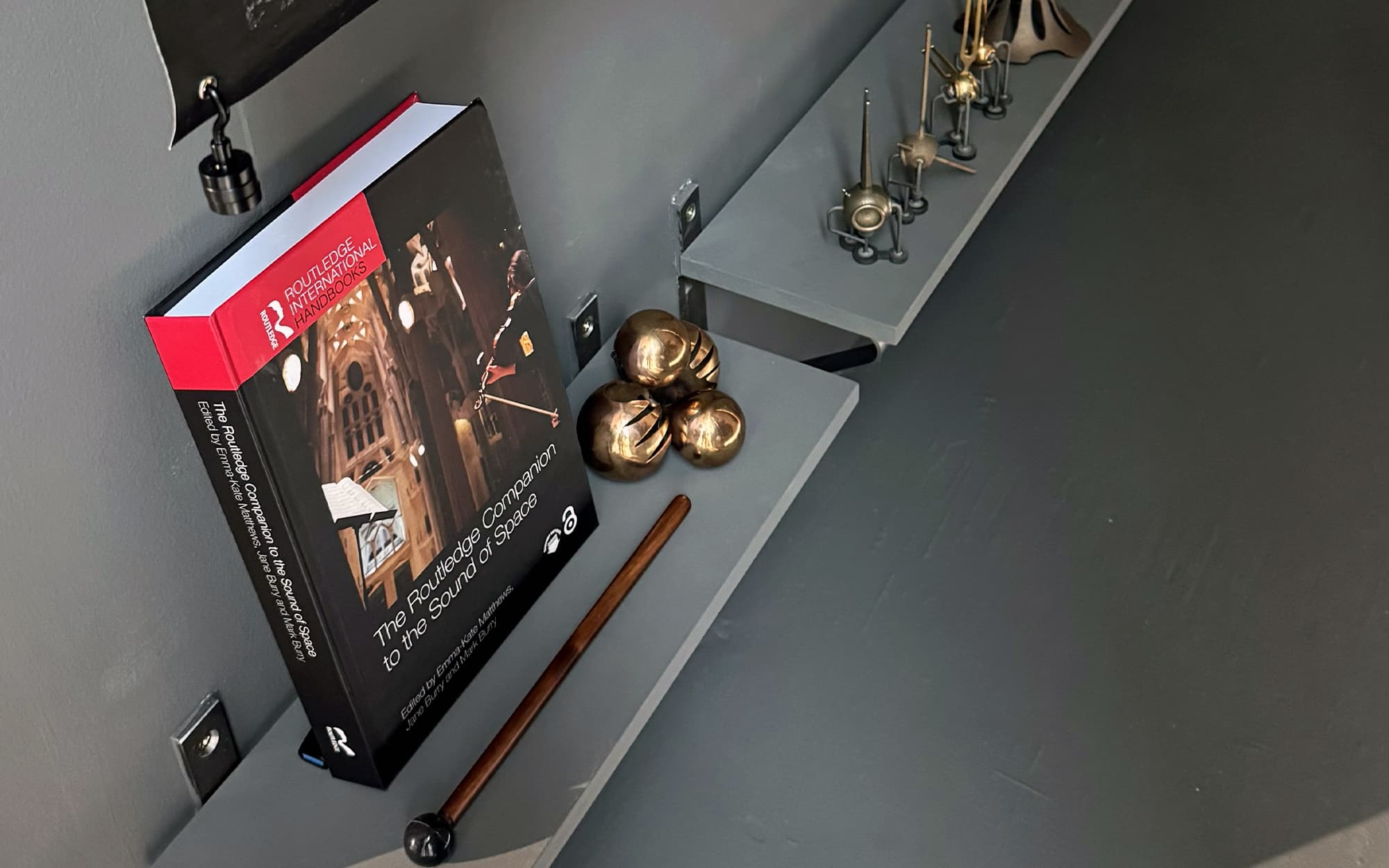
The Routledge Companion to the Sound of Space, book launch and exhibition at the Bartlett School of Architecture 2025
The Routledge Companion to the Sound of Space, book launch and exhibition at the Bartlett School of Architecture 2025.
The book has already begun to attract scholarly citations and inclusion in academic repositories, and its presence on reading lists across architecture, music, and art programmes suggests that the conversations it sought to open are finding their audience. Looking ahead, the most exciting prospect is not just the growth of spatiosonic research as its own niche domain, but its integration into broader cultural, educational, and institutional contexts. If space can be understood as something that can sound, listen, respond, and learn, then the design of future environments, whether museums, performance spaces, public buildings, or digital platforms, may increasingly be shaped through sonic as well as spatial thinking and doing.
In this sense, the Companion was never intended as a definitive statement, but as an open framework and a starting point for ongoing dialogue about how we make space, how we make sound, and how these practices might continue to inform one another in the years to come. That the book has already catalysed new networks, events, and encounters, including this one, suggests that the dialogue is well underway!
- 1
(Matthews 2024)
- 2
See (Zhao and Burry 2024) And (Belanger, Newell, and McGee 2024) And (Alambeigi and Burry 2024) Amongst many others.
- 3
See (Fowler and For 2024) For example.
- 4
See (Anderson 2024) And (Panourgia 2024)
- 5
See (Garthwaite 2024) And (McDonnell 2024)
- 6
See (Samartzis 2024)
- 7
See (Sharma 2024) And (McArthur and Margetson 2024) And (Bavister 2024)
- 8
See (Parker and Novo 2024) And (van Tonder 2024)
- 9
See (Ouzounian and Werner 2024)
- 10
See (Tyrrell 2024) And (Drever 2024)
- 11
See (“CMMR 25” n.d.)
- 12
The most up-to-date discussion of this can be read in (Matthews 2025)
- 13
A term I often borrow, and first learned from (Ingold 2017)
Emma-Kate Matthews
Dr Emma-Kate Matthews (b. 1986) is an architect, composer, musician and digital artist whose work explores the intersection of sound and space. Her research focuses on what she terms spatiosonic practice—the reciprocal relationship between making sound and shaping space—developed through site-specific audio-visual works, custom instrument design and architectural research. Her music has been performed internationally at venues including the Basílica de la Sagrada Família, Southbank Centre, the Barbican and Brighton Festival, and was recently presented at URANIA in Zagreb, where Betwixt & Between premiered with Ansambl Synchronos in 2025. She has composed for the London Symphony Orchestra’s Panufnik Composers’ Scheme and released electronic-classical works on labels including Algebra, NMC and Accidental Records. Her music has been broadcast on BBC Radio 3, Resonance FM and Tokyo Radio. Matthews completed her PhD at the Bartlett School of Architecture (UCL) in 2025 and is currently Associate Professor there.
Article topics
Article translations are machine translated and proofread.
Artikel von Emma-Kate Matthews