


Spatial Audio – A Free Practical Guide for Audio Creators


For anyone with basic audio production knowledge, this free course opens the door to spatial audio. Learn principles, psychoacoustics, and creative applications through interactive lessons and real-world case studies, exploring Ambisonics, Dolby Atmos, and beyond.


Daniel Deboy

Karolina Jaruszewska
Jens Ahrens


Veröffentlichung


Reading time
4 Minuten

Loading the Elevenlabs Text to Speech AudioNative Player...

Spatial audio holds the potential for more immersive and expressive listening experiences, yet practical, method-oriented knowledge about how such experiences are created has often been difficult to access. Much of the available information has traditionally been split between academic research and vendor-driven resources, the latter typically focused on specific tools or formats rather than transferable principles. The course Spatial Audio - Practical Master Guide was initiated to close this gap by framing spatial audio as a perceptual and methodological discipline, grounded in psychoacoustics and informed production practice.

What it is

Spatial Audio – Practical Master Guide is an online educational resource that teaches the learners the most important concepts in spatial audio content creation. This includes the underlying psychoacoustics, capture and reproduction technologies and formats, delivery formats, applications, and aesthetic considerations. The content is provided through lessons, step-by-step guides, and case studies that are supported by a variety of audio examples and interactive elements that encourage exploratory, hands-on learning. Many of the course components are self-sufficient so that they can be used in isolation or be integrated into other educational contexts. The content is published under Creative Commons license [CC BY-NC-ND 4.0] and is available in English, Polish, and German. Those parts of the course that are not interactive can be downloaded in pdf format.

Where you can find it

https://spatial-audio.acoucou.org/

Who it is for 

The course aims at practitioners like music producers, sound designers, and post-production engineers who have a basic understanding of audio engineering and would like to extend their skill portfolio to include spatial audio. The course assumes that the learners are, for example, familiar with using a digital audio workstation or understand what a microphone directivity is and how it influences the sound that is being captured. The course is designed both for individual self-learners and for educators or institutions seeking modular, high-quality teaching material for spatial audio.

How it came about

Spatial Audio – Practical Master Guide was led by Karolina Jaruszewska of KFB Technologies and developed by an international consortium bringing together research, education and industry expertise. The consortium comprised the acoustics consultancy KFB Acoustics, the content creation studio DELTA Soundworks, the tech solution provider Jazzy Innovations, the sound department of the Lodz Film Academy, and the Audio Technology Research Group at Chalmers University of Technology. The project was developed between 2023 to 2025 and received support from the Erasmus+ Vocational Training Programme of the European Commission.1

What it contains

Spatial audio is a term that was established in the community only a couple of years ago. Previously, a variety of terms like 3D sound, immersive audio, or also surround sound were used (and partly keep being used) to refer to the same concept. 

Interactive graphics

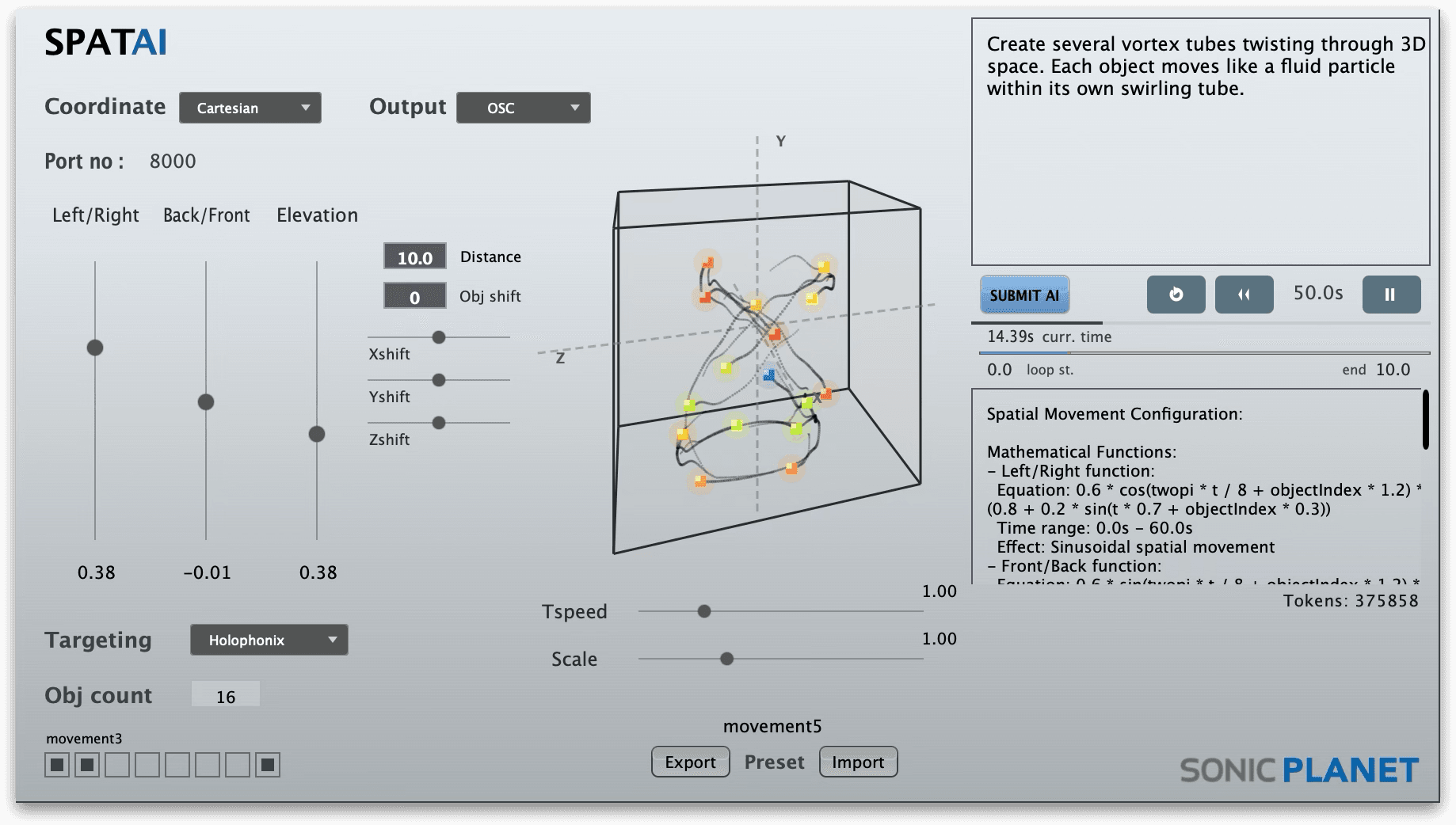
Interactive graphics invite the reader to explore the course content, for example the different elements in a 360° film production environment. See step-by-step guide

In the course, we define Spatial Audio as audio in which spatial information, most notably the positions of sound events and the virtual environment they occupy, offers more degrees of freedom than in stereophony. The constraints of stereophony have historically shaped established aesthetics that essentially became the norm we are accustomed to. We assume no such limitations: sound sources can be placed behind, above, or around the audience, and reverberation can reflect physically plausible and implausible spaces, allowing creators to design the spatial experience that best suits their own sonic ideas. The course does not prescribe specific arrangements, such as how a musical band should be arranged in space or which reverberation should be used. It rather aims at supporting the learner in developing a comprehensive understanding of the psychoacoustical and technical aspects of Spatial Audio to thereby equip the learner with a skillset that enables them to implement their sonic visions.

Full dome

Loudspeaker configurations of different real-world venues are depicted for several showcases, like the one of Experimenta’s Science Dome in Heilbronn, Germany.  See showcase

The fundament for this is laid by the 31 Lessons that the course comprises that are organized into seven chapters:

  • Chapter 1: Overview (introduction, history of spatial, evolution of aesthetics in spatial audio)
  • Chapter 2: Psychoacoustics (spatial hearing, perception of reverberation)
  • Chapter 3: Reproduction (loudspeaker arrays, headphones)
  • Chapter 4: Capture (microphone arrays)
  • Chapter 5: Ambisonics (capture, reproduction, editing of ambisonic content)
  • Chapter 6: Storing spatial audio content
  • Chapter 7: Delivery formats

The course features eight case studies that showcase the diversity of spatial audio applications. Among the highlights are live performances at the Krakow Film Music Festival and Friedrichstadt-Palast Berlin, immersive installations at Experimenta Science Dome, and innovative industry applications such as spatial audio in automotive environments and a Dolby Atmos streaming truck.

To turn theory into practice, the course includes five hands-on step-by-step guides that walk learners through key spatial audio workflows and techniques. The step-by-step guides include: channel-based production for music, Dolby Atmos mixing for cinema, ambisonics sound production for 360 film, DIY ambisonic microphone arrays, and interactive spatial audio with virtual acoustics.

The guides are designed to be largely tool-agnostic and focus on concepts and techniques that can be applied across different software and hardware environments.

Echoes of Space

Showcases contain interviews and location shots, like this one about the “Echoes of Space” concert at the Krakow Film Music Festival (FMF). See showcase

Virtual Acoustics

This video from the tutorial about interactive spatial audio in game engines shows the different effects in virtual acoustics like early reflections, occlusion and room coupling. Use headphones when watching the video. See step-by-step guide

Summary

From foundational concepts to hands-on workflows, Spatial Audio – Practical Master Guide offers a way to understand and experiment with sound in three dimensions. Whether for personal projects or classroom use, the course provides the tools and insights to explore spatial audio beyond conventional limits, encouraging learners to shape immersive experiences in their own creative ways.


Daniel Deboy, Karolina Jaruszewska, Jens Ahrens

Daniel Deboy is a partner and co-founder of DELTA Soundworks in Heidelberg, Germany. As technical planner and mixing engineer for immersive audio experiences, he has worked on award-winning projects recognised for innovation and best sound in Virtual Reality, Fulldome, and Location-Based Entertainment (LBE). Daniel is regularly engaged in teaching seminars and workshops, among others at the Popakademie and Filmakademie Baden-Württemberg, where he challenges students to think beyond traditional audio and embrace the creative potential of spatial audio. He sees space as a powerful storytelling tool to shape narratives and evoke a sense of presence.

Karolina Jaruszewska is a Project Manager specializing in acoustics at KFB Technologies. A graduate of the Faculty of Electronics at Wrocław University of Technology, and of the postgraduate Master Class of Management program at SWPS University. Former Chair of the Technical Committee for Education at the EAA. Since 2014, she has overseen international educational projects at KFB Technologies and serves as the coordinator of the acoucou.org educational platform. She is a co-author of the illustrated book “Halo! Tu dźwięk!”. Her work focuses primarily on interdisciplinary areas bridging science, engineering, and art.

Jens Ahrens is a Professor and head of the Audio Technology Group at Chalmers University of Technology in Gothenburg, Sweden. His former affiliations include Microsoft Research, Reality Labs, and Stanford University in the USA. Jens conducts and leads research on a variety of topics in the fields of spatial audio capture and reproduction and the underlying psychoacoustics. He is a member of the editorial boards of several international scientific journals on audio signal processing.



Article topics


Original language: English
Article translations are machine translated and proofread.